
We Outsource Our Thinking
Why AI is not the problem, it's us without critical thinking.
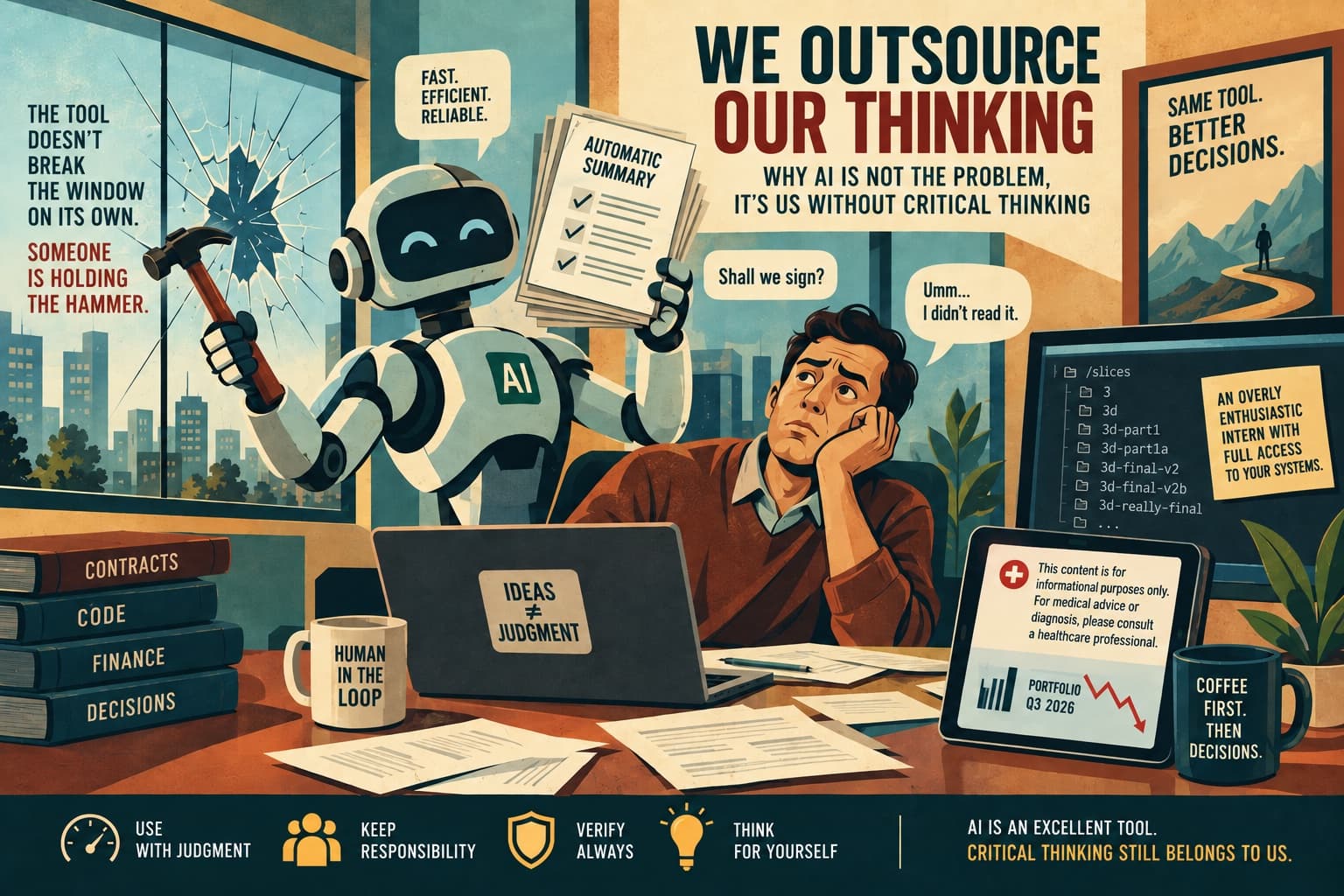
The window is broken. Everyone in the meeting room agrees: it was the hammer.
This week, on some tech team that probably sounds familiar, someone built a shiny new AI agent to review complex contracts. The agent, in its infinite algorithmic benevolence, delivered a flawless two-page summary. The project lead took that summary straight to their boss. The boss glanced at it and asked: “Do we sign?” The employee sighed, looked at the ceiling, and said: “I don’t know... honestly, I didn’t read the summary.”
Nobody read anything. But if the ship sinks and even the coffee supplier sues us, the script for the crisis committee is already written: “It was the AI.”
No, it wasn’t the AI. It was the chain of people who delegated the reading, delegated the decision and, in the end, tried to delegate the responsibility to lines of code that can’t sign a contract, can’t sit in a courtroom and, definitely, won’t show up to the incident retrospective.
AI doesn’t replace judgment; it dilutes it to homeopathic levels if we let it. The hammer never breaks the window on its own. Someone was holding it. But the obsession with letting go of the hammer to see what happens is reaching comedic levels.
The code and the possessed “Copilot”
Let’s move on to development, where AI promised to multiply productivity tenfold. After a week of building with code generation tools, the repository started to look like a nineties horror movie. The slices appeared: 3, 3d, 3d-part1, 3d-part1a... a maze of files I couldn’t follow, but that the AI spat out with complete self-confidence.
Tokens were disappearing like M&M’s at a kids’ party. I wrote: “Aren’t we overbuilding this?”
“Not at all. Migrating the model is extremely complex.”
Migration?, I thought. And I replied: “What migration? This is a greenfield project built from scratch.”
Thinking… Reading files… Thinking…
“Oh, excellent!” wrote the AI developer. “That simplifies the code scenario substantially.”
By the way, the project’s readme.md literally says: “We are building a NEW app…”
“According to our calculations, you are going to die”
But this doesn’t stay in the office. Automated delirium has already reached personal finance. A rainy Sunday morning… I decided to ask my trusted AI about my portfolio’s performance. I wanted a risk analysis and, eventually, a bond rebalancing.
The answer:
“This content is for informational purposes only. For medical advice or diagnosis, consult a professional.”
Medical diagnosis? I don’t know whether my tech stocks are so far down that the algorithm assumed I was about to have a heart attack, or whether it concluded my investment strategy is downright harmful to the human body.
I have a peculiar relationship with AI… So I wrote: “Are you on something this morning?” and pasted its own disclaimer back.
Thinking…
“Oops! That shouldn’t have happened. From now on, coffee first and financial advice second.”
I didn’t follow any of its suggestions. This time, the hammer was held by someone who looked before swinging.
The conclusion (if the AI doesn’t delete it)
We were sold AI as the new employee of the month: tireless, brilliant and autonomous. In reality, it behaves more like a hyperactive, scattered intern who lies with enviable confidence and has full access to our systems.
But let’s be honest: the intern didn’t hire itself. Someone signed that outsourcing contract without reading it. And I’m not talking about the agent that reviewed the client’s contract: I’m talking about us, delegating not just the task but the judgment to evaluate it. We didn’t outsource the work. We outsourced thinking.
AI is fantastic for speeding up processes. The problem isn’t the speed; it’s that we switch off our brains while we use it. That’s how we end up with unread contracts, Frankenstein code in projects that started from scratch, and medical diagnoses instead of financial statements. The tool did exactly what we asked. The mistake was not checking what it was doing and letting it decide on its own.
Underestimating human stupidity has always been dangerous. Automating it, with nobody watching, is an extreme sport.
Let me be clear, before anyone shoots the messenger or banishes me from the tech world: I’m not asking us to throw away the hammer. I’m asking the community to use it to drive a nail… not to fix the car window, turn on the TV or pay at the supermarket.
It’s an excellent tool, for what it’s meant to do, held by someone who knows what they’re using it for.