
From Rollercoasters to Mars
An essay on controlled energy, electromagnetic launch systems, electric propulsion, and why efficiency often arrives quietly before it accelerates.
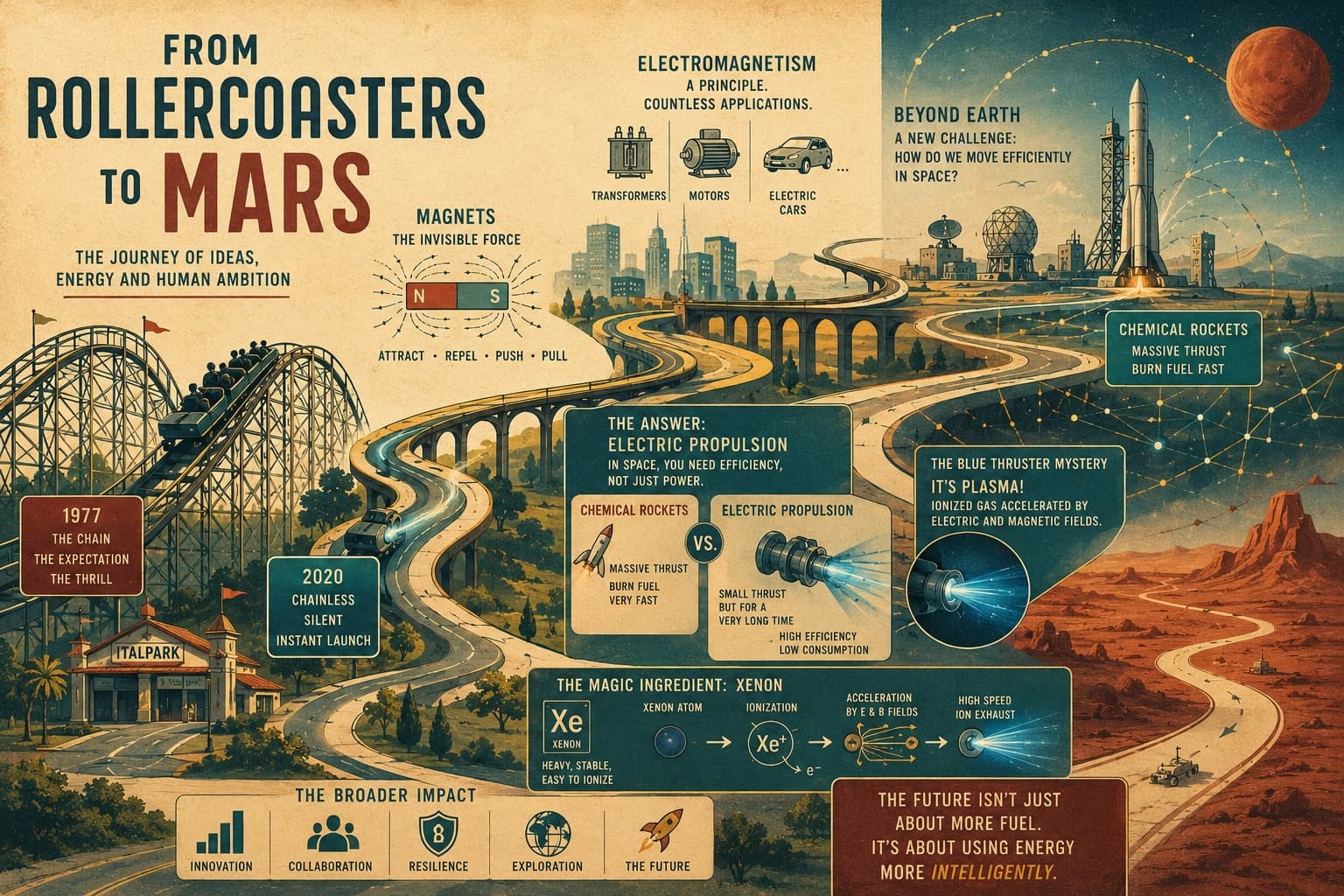
I love rollercoasters.
Especially the new ones.
And by “new,” I do not just mean taller, faster, or more terrifying.
The first rollercoaster I remember riding was at Italpark, in Buenos Aires. It was 1977.
There were actually two of them, and both had the classic chain lift.
You know the sound: clac-clac-clac-clac…
Then silence.
Then the thrill began.
For decades, that was my idea of a rollercoaster.
You climb slowly.
You wait.
You drop.
I rode many of those chained rollercoasters over the years. I still enjoy them. But around 2020, I rode one of the newer launch coasters.
No chain.
No slow climb.
No clac-clac-clac.
Just silence.
And then, suddenly, you are pushed to more than 100 km/h in a few seconds.
That changed the experience completely. That and going through tighter security than an airport.
So I did what I usually do when something surprises me: I went looking for how it worked.
The answer was something we have all played with since childhood.
Magnets.
Attract. Repel. Push. Pull.
In more technical terms: electromagnetism.
I am not going to turn this into a physics lecture. The short version is that electromagnetic forces can be controlled, sequenced, and used to produce motion. In some launch rollercoasters, powerful electric systems create magnetic fields that push or pull the train forward at very high speed.
No chain.
No cable pulling you up.
Just controlled force.
That idea is everywhere.
It is in transformers.
It is in electric motors.
It is in generators.
It is in electric cars.
It is in industrial systems, trains, speakers, MRI machines, and many other technologies that quietly move the modern world.
And that brings me to Mars.
No, not Mars bars. No candy involved here.
With Artemis, renewed lunar ambitions, reusable rockets, and the idea of using the Moon as a stepping stone for deeper space, the propulsion question becomes unavoidable:
How do we move efficiently once we are already in space?
Chemical rockets are extraordinary for launch. They produce enormous thrust, which is exactly what you need to escape Earth’s gravity. When you are sitting at the bottom of a gravity well, subtlety is not the objective. You need violence, pressure, heat, and acceleration.
But deep space is a different problem.
Once a spacecraft is already in orbit, or moving through the vacuum, the challenge is no longer only brute force. It becomes endurance, efficiency, and how much propellant you can afford to carry.
That is where electric propulsion becomes fascinating.
Some spacecraft use electricity to accelerate charged particles and expel them at extremely high speed. The thrust is small compared with a chemical rocket, but it can continue for long periods.
Instead of one violent push, it is a steady, efficient acceleration.
And that finally answered a childhood mystery for me:
Why are some spacecraft thrusters blue?
Because in some electric propulsion systems, what you are seeing is not fire in the usual sense.
It is ionized gas.
A controlled stream of charged particles being accelerated by electric and magnetic fields.
And then I found the part that made the whole thing even more interesting: xenon.
Some electric propulsion systems do not burn fuel the way a normal rocket does. Instead, they use a gas — often xenon — as a propellant.
Why xenon?
Because it is heavy, stable, and relatively easy to ionize. In simple terms, the engine gives xenon atoms an electric charge, turning them into ions. Then electric and magnetic fields accelerate those ions and throw them out of the back of the spacecraft at extremely high speed.
That stream of particles creates thrust.
Not the brutal, explosive thrust you need to leave Earth.
Something much smaller.
Much quieter.
But also much more efficient.
A chemical rocket is about power.
Electric propulsion is about patience.
A chemical rocket gives you a massive push and consumes propellant very quickly.
An ion or Hall-effect thruster produces a small push, but it can keep pushing for a very long time. It trades raw thrust for efficiency and endurance.
That is the part I find fascinating.
The same broad family of ideas that launches a rollercoaster without a chain may also help move spacecraft across deep space.
From clac-clac-clac in Italpark…
to silent magnetic launch systems…
to blue plasma thrusters pushing xenon ions into the dark.
The future of propulsion may not be only about carrying more fuel.
It may be about using energy more intelligently.
Sometimes the future does not arrive with noise.
Sometimes it arrives silently.
And then it accelerates.