
From 2nm Transistors to Football Fields
A scaling exercise showing how simple AI conversations become racks, megawatts, liquid cooling, and industrial infrastructure.
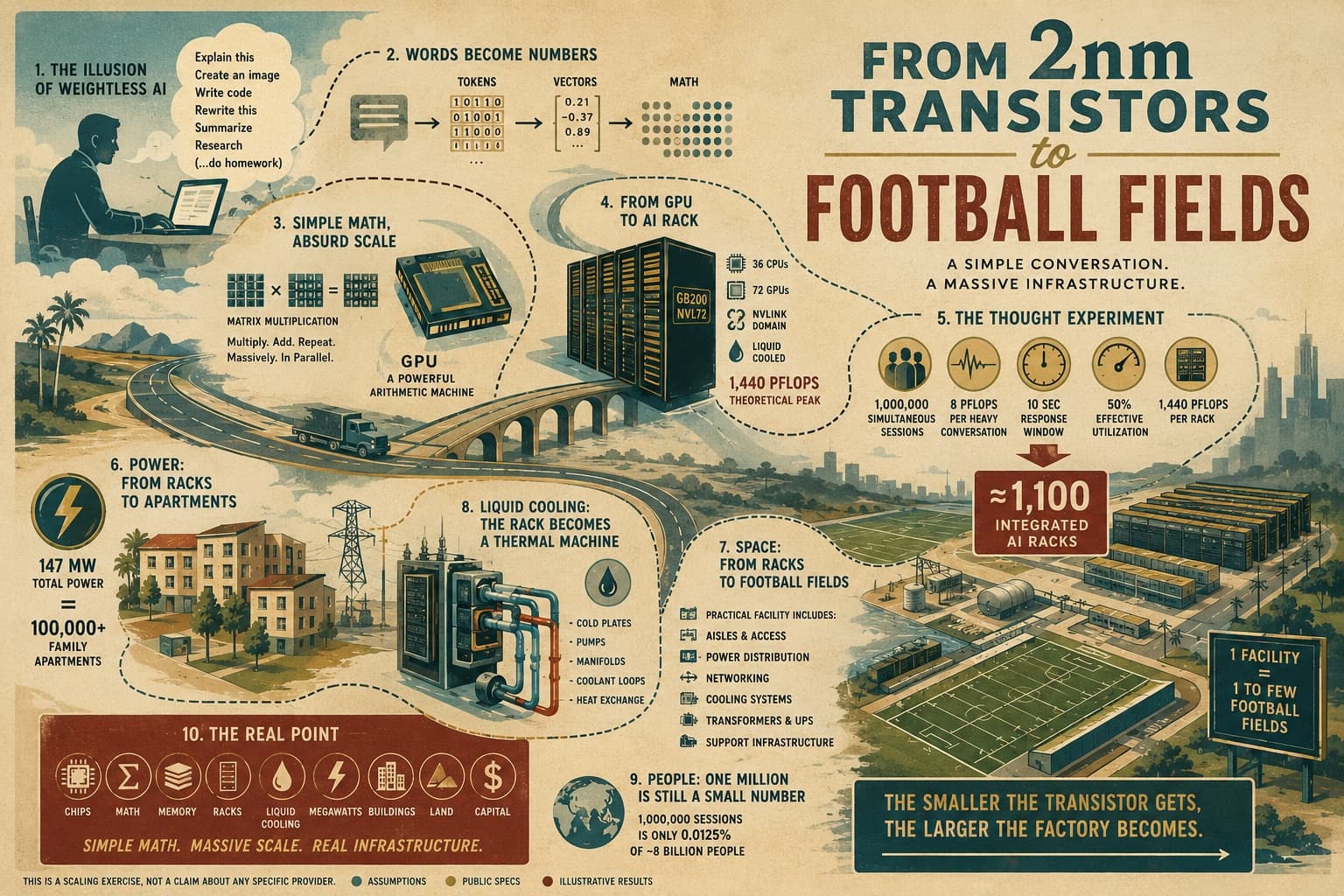
Note: This is a directional scaling exercise, not a claim about the infrastructure of any specific AI provider. Public NVIDIA and HPE rack specifications are used as hardware references; the workload assumptions are intentionally illustrative.
1. The illusion of weightless AI
I am curious by nature. When a problem becomes too abstract, I look for analogies and numbers that make it visible. Sometimes precise answers are difficult to obtain, so you assume a scenario and work with it until it is directionally correct.
We use AI as if it were weightless.
- Ask for an explanation.
- Create an image.
- Write code.
- Rewrite a text.
- Summarize a document.
- Research a topic.
- Sometimes, unfortunately, do homework.
The experience is simple. You type something, wait a few seconds, and an answer appears.
That simplicity creates an illusion: someone on the other side answering back.
In one sense, yes: there is a system responding. In another sense, no: there is no person typing. The system is not reading and thinking like we do. It is processing tokens, probabilities, vectors, and mathematical operations.
Most of what happens is invisible.
We see the answer. What we do not see is the 99% underneath.
Behind each response are models, chips, memory, interconnects, racks, cooling systems, software layers, data centers, electricity contracts, transformers, and capital investment.
As an electronic engineer with more than 30 years in the technology market, I expected the numbers behind AI to be large. I was still surprised by how fast the scale grows.
The paradox is that AI starts at microscopic scale and ends at industrial scale.
We are pushing chip manufacturing into the 2nm era. Transistors are becoming unimaginably small. But when AI is deployed to millions of users, the infrastructure expands outward into racks, megawatts, cooling loops, and facilities measured in football fields.
The smaller the transistor gets, the larger the factory becomes.
So I decided to do simple math and turn the 99% into something tangible.
2. Words become numbers
AI does not receive words the way we do. It first turns text into tokens. Those tokens are then mapped into numerical representations, and those representations move through layers of mathematical operations.
The answer may look like language. Underneath, it is numbers.
In the machine, many of those numbers are floating-point numbers: values with decimals, the ones many of us did not enjoy in school. In AI systems, they become the basic material for computation.
3. Simple math, absurd scale
In a simplified explanation, AI workloads depend heavily on matrix multiplication. Matrix multiplication is mostly repeated multiply-add operations. Multiply numbers. Add numbers. Repeat. Do it massively in parallel.
A GPU is not intelligent in the human sense, but it is very good at numbers. It is an extremely powerful arithmetic machine.
So the magic is not that each individual operation is complicated. The magic is that the system performs a staggering number of simple operations, coordinated through model architecture, memory, interconnect, software, and probability.
4. From GPU to AI rack
A normal Nvidia card in a PC usually has one GPU chip. A data-center AI server may have multiple GPUs. A rack-scale AI system goes further.
Nvidia GB200 NVL72, for example, connects 36 Grace CPUs and 72 Blackwell GPUs in a rack-scale, liquid-cooled design with a 72-GPU NVLink domain. Nvidia lists the system at 1,440 PFLOPS of theoretical peak performance in a low-precision AI format.
FLOPS means Floating Point Operations Per Second — in plain English, how many calculations using approximate real numbers a system can perform every second. The prefixes scale by factors of a thousand: kilo (10³), mega (10⁶), giga (10⁹), tera (10¹²), peta (10¹⁵), exa (10¹⁸). So, one PFLOP is one quadrillion operations per second, and 1,440 PFLOPS is 1.44 exaFLOPS — roughly 1.44 billion billion calculations every second.
5. The thought experiment
This is not a claim about any specific LLM provider. It is not a rack count for any company. It is a scaling exercise using public specifications and explicit assumptions.
I assumed:
- 1 million simultaneous active AI conversations / sessions.
- 8 PFLOP-equivalent operations per heavy conversation.
- A 10-second response window.
- One rack-scale AI system at 1,440 PFLOPS theoretical peak.
- 50% effective utilization.
One million simultaneous sessions is not meant to represent an average day or a specific provider. It is a stress-test number: large enough to expose the physical consequences of AI at consumer scale, but still tiny compared with the global population.
The 8 PFLOPs per conversation assumption depends heavily on model size, context length, output length, batching, routing, caching, precision, and software efficiency. So, a lightweight chat might be 10x less; a multimodal or long-context query could be 10x more. Treat it as an illustrative heavy-conversation estimate, not a measured fact.
Now the math:
1,000,000 conversations times 8 PFLOPs equals 8,000,000 PFLOPs.
One 1,440 PFLOPS rack running for 10 seconds produces 14,400 PFLOPs of theoretical compute.
At 50% effective utilization, that becomes 7,200 usable PFLOPs per rack over 10 seconds.
8,000,000 divided by 7,200 gives roughly 1,111 racks.
Call it 1,100 integrated AI racks.
That is the moment where the abstraction changes. The conversation no longer feels like software only. It becomes physical.
6. Power: from racks to apartments
Using roughly 1,100 AI racks implies roughly 80,000 high-end GPUs.
Using HPE's GB200 NVL72 implementation as a reference, each rack consumes 132 kW of power, with 115 kW liquid-cooled and 17 kW air-cooled.
At 132 kW per rack, 1,111 racks lands at roughly 147 MW of rack power.
How much is that?
A typical 3-bedroom / 2-bath apartment with four people might average around 900 kWh per month, or about 1.25 kW of continuous power.
At that estimate, one 132 kW AI rack draws roughly as much continuous power as about 100 family apartments.
The 1,100-rack thought experiment lands around the continuous electricity use of more than 100,000 family apartments.
Again, this is an analogy, not a utility-engineering model. But it gives the scale.
7. Space: from racks to football fields
The racks alone do not occupy football fields. A rack footprint might be around 0.72 square meters. But data centers cannot pack racks wall-to-wall. They need aisles, service access, power distribution, networking, liquid-cooling manifolds, pumps, safety systems, maintenance space, and facility infrastructure.
For 1,100 racks, practical white space might be several thousand square meters. The full facility, including electrical rooms, cooling systems, transformers, UPS, corridors, loading areas, and support infrastructure, can move into the range of one to a few football fields.
That is why the football-field analogy works, but with a caveat: it is not just the cabinets. It is the facility needed to feed, cool, connect, and operate them.
8. Liquid cooling: the rack becomes a thermal machine
Liquid cooling is the clearest sign of this shift — and the reason 1,100 racks cannot simply be stacked in a warehouse. Let us digress for two minutes.
Traditional data centers used cold and hot aisles. Fans moved cold air through the equipment and pushed hot air to the other side, removing heat from the electronics.
As chips became denser and AI accelerators became more power-hungry, the bottleneck moved beyond transistor scaling. The question was no longer only how small the features could get, but how much heat could be removed from a very dense package and then from a very dense rack.
The liquid coolant usually does not flow over bare electronics. It flows through sealed cold plates and channels attached to the hot packages. But operationally, the rack now has plumbing.
The AI rack becomes a thermal machine.
This is important because liquid cooling is not just about reducing temperature. It is what allows this compute density to exist.
At 5 or 10 kW per rack, air cooling works. At 100 kW-plus per rack, air becomes the wrong transport medium for the main heat load.
The infrastructure problem changes. It is no longer only: can we make the transistor smaller?
- Can we remove the heat?
- Can we power the rack?
- Can we feed the GPUs with memory bandwidth?
- Can we connect them fast enough?
- Can we build the facility close enough to power?
- Can we cool it reliably?
- Can we operate it economically?
End of digression. This is why the facility grows beyond the racks themselves — and why the football-field analogy holds.
9. People: one million is still a small number
By traditional data-center standards, 1,100 racks may not sound enormous. Some of the largest campuses can contain more than 10,000 racks. But at 100 kW-plus per rack, a thousand AI racks can become a hundred-megawatt-class facility.
That is the direction.
And one million simultaneous conversations is not even a large fraction of humanity. Against a global population of roughly 8 billion, one million simultaneous sessions would represent about 0.0125% of a global population of roughly 8 billion people. It is 1% only if the reference population is about 100 million.
The conclusion is that consumer-scale AI turns text generation into industrial infrastructure.
10. The real point
A single answer feels weightless. At scale, it is not.
It is chips. It is math. It is memory. It is racks. It is liquid cooling. It is megawatts. It is buildings. It is land. It is capital.
AI may begin as simple math. But at scale, simple math becomes football fields.
Illustrative model
| Variable | Working assumption / result |
|---|---|
| Simultaneous active AI conversations / sessions | 1,000,000 |
| Compute per heavy conversation | 8 PFLOPs |
| Response window | 10 seconds |
| Effective utilization | 50% |
| Required racks | About 1,111 |
| GPUs | About 80,000 |
| CPUs | About 40,000 |
| Rack power | About 147 MW |
| Apartment equivalent | 100,000+ family apartments |
| Facility footprint | Order of one to a few football fields |
So:
- AI is not weightless.
- AI is not just software.
- AI is industrial infrastructure hiding behind a clean interface.
If questions like “why one million sessions?”, “why 8 PFLOPs?”, or “what happens with newer hardware?” started popping into your mind, good.
Change the assumptions and run the model again. The exact number will move. The direction probably will not.
Back to all articles