
In an IPO, don’t look only at the company
A short article on why investors should separate the quality of a company from the structure of the offering, especially when a limited float creates temporary scarcity.
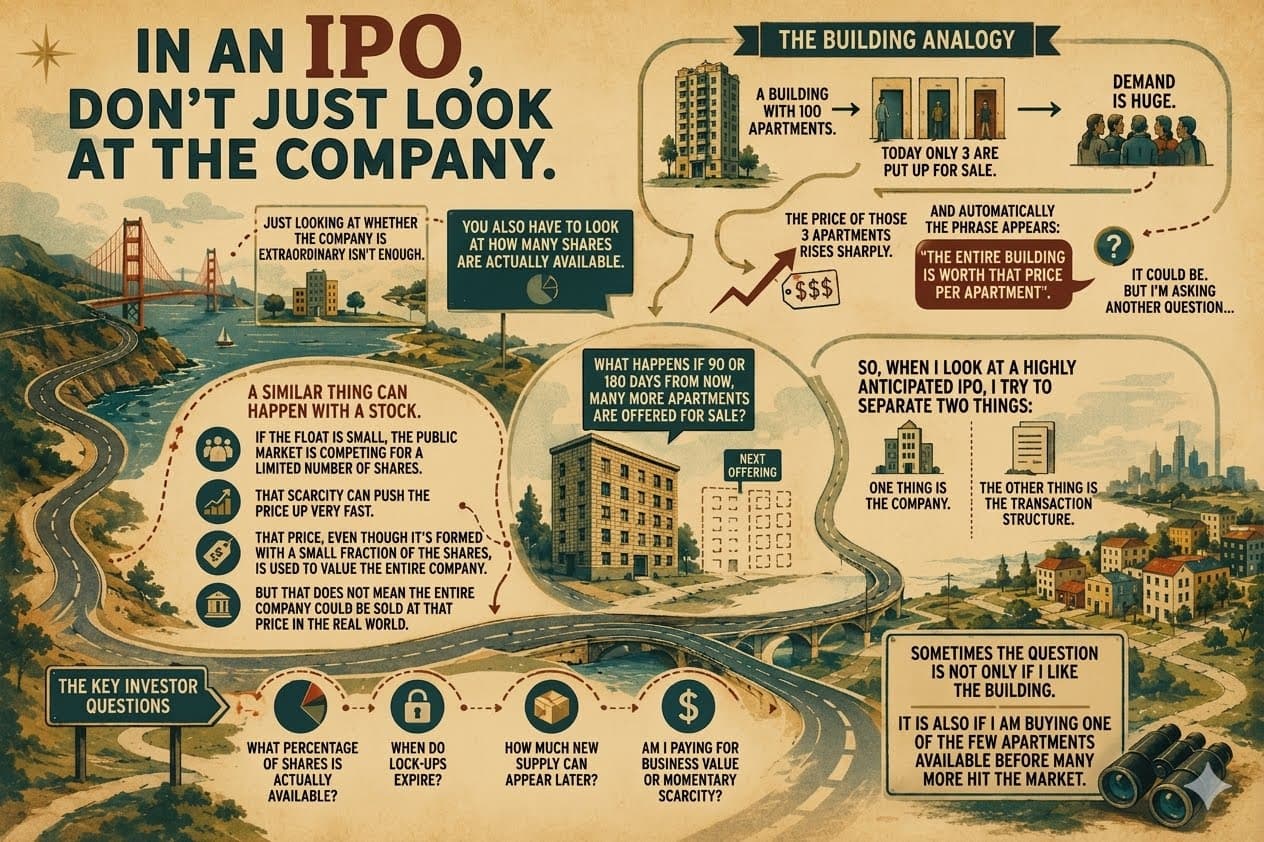
In an IPO, don’t look only at the company.
Also look at how many shares are actually available.
These days I found myself thinking again about something that often gets lost when an IPO generates a lot of excitement.
It is not enough to ask whether the company is extraordinary.
You also need to look at how many shares are actually available.
The discussion around major IPOs — including recent and highly anticipated cases like SpaceX, with its very limited float — made me think of a simple analogy.
Imagine a building with 100 apartments.
Today, only 3 are for sale.
Demand is huge. Everyone wants in. The building is attractive, the location seems unique, and nobody wants to miss out.
So the price of those 3 apartments rises sharply.
And almost automatically, people start saying:
“The whole building is worth that price per apartment.”
Maybe.
But as an investor, I ask myself another question:
What happens if, in 90 or 180 days, many more apartments come up for sale?
Something similar can happen with a stock.
If the float is small, the public market is competing for a limited number of shares. That scarcity can push the price up very quickly.
And that price, even if it is formed from a small portion of the shares, is then used to value the entire company.
But that does not mean the entire company could actually be sold at that price in the real world.
That is why, when I look at a highly anticipated IPO, I try to separate two things:
One thing is the company.
Another thing is the structure of the offering.
I may like the company a lot and still ask myself:
What percentage of shares is actually available?
When do the lock-ups expire?
How much new supply could appear later?
Am I paying for business value, or for temporary scarcity?
Sometimes the question is not only whether I like the building.
It is also whether I am buying one of the few apartments available before many more come to market.